15 Walkie-Talkie Games for Kids + Radio Lingo Cheat Sheet (2026 Guide)
By the Orbit Pals team · · 7 min read
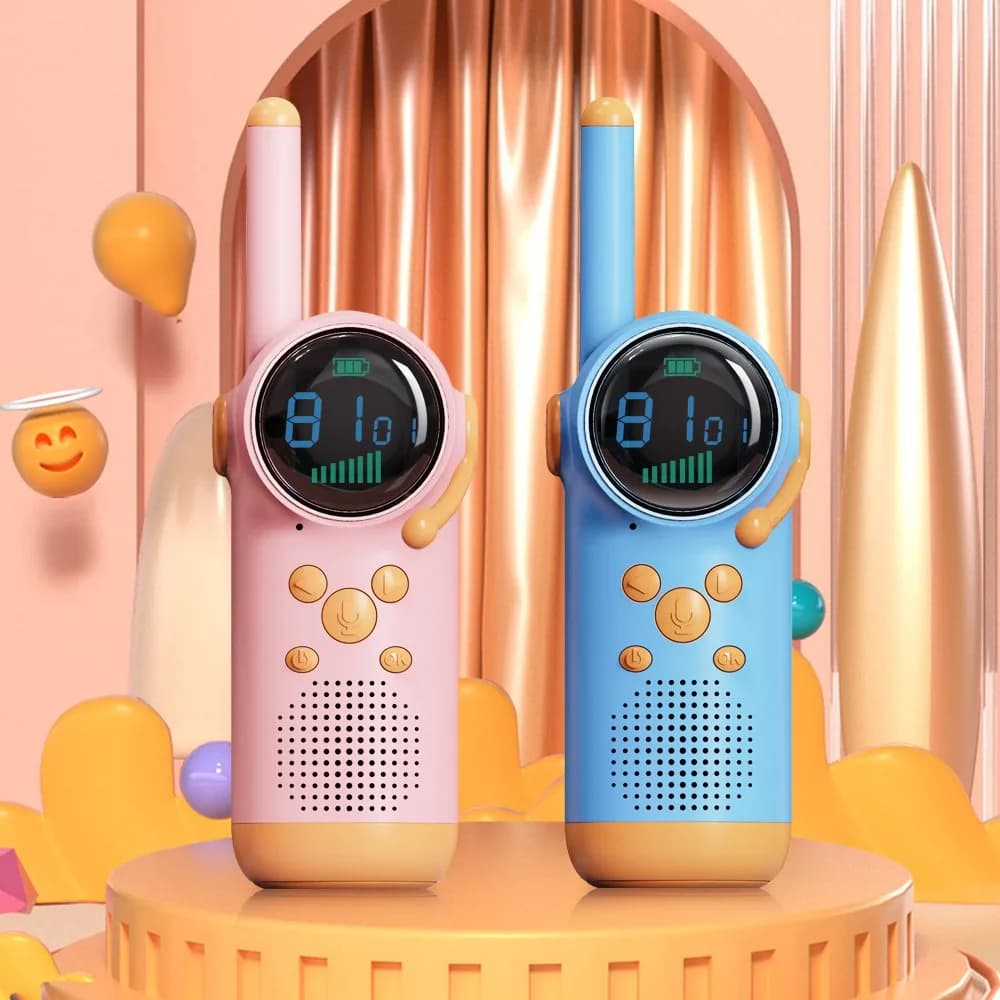
Hand a kid a walkie-talkie and something magical happens: they start talking in “Roger that” and “Over and out,” the backyard turns into a secret base, and nobody asks for a tablet for hours. Here are our favorite walkie-talkie games for kids, a lingo cheat sheet, and what to look for when you buy a pair.
How to use a kids' walkie-talkie (30-second version)
- Turn both radios on.
- Pick the same channel on both. Radios only hear each other on the same channel.
- Hold the talk button, wait a beat, then speak. Let go to listen — only one person can talk at a time.
- Finish with “Over” so the other person knows it's their turn.
Walkie-talkie lingo cheat sheet
Teaching kids a few “real” radio words is half the fun — and it keeps conversations from getting jumbled.
| Say | Means |
|---|---|
| Roger | I got your message. |
| Copy | I hear you loud and clear. |
| Over | I'm done talking — your turn. |
| Out | This conversation is finished. |
| 10-4 | OK / understood. |
| Wilco | Will comply — I'll do it. |
| Say again | Please repeat that. |
| Stand by | Wait a moment. |
| What's your 20? | Where are you? |
| Breaker, breaker | I'd like to talk on this channel. |
15 walkie-talkie games for kids
- Mission Control Scavenger Hunt (Outdoors) — One player stays at "mission control" with the list and radios clues; the explorer finds each item and reports back.
- Hide-and-Seek with Clues (Indoors or out) — The hider gives one radio clue every minute ("I can see something green…") until they're found.
- Secret Agent Mission (Anywhere) — Write a mission card, give each agent a code name and use only radio lingo. Bonus points for a secret password.
- Treasure Map Navigator (Backyard or park) — One kid holds the map and guides the other to hidden treasure: "Ten giant steps to the big tree. Over."
- I Spy Over the Radio (Car, house or yard) — Classic I Spy — but the players are in different places, so describing things gets creative.
- Simon Says: Radio Edition (Outdoors) — Simon gives commands over the radio. Another grown-up or older kid watches to see who gets caught.
- Story Chain (Anywhere) — Each player adds one sentence to a story, says "Over," and passes it on. Great for bedtime and rainy days.
- Twenty Questions (Anywhere) — Think of an animal, food or object. Others ask yes/no questions over the radio — 20 tries to guess.
- Obstacle Course Commander (Backyard) — The commander radios directions to get the runner through a course of cones, hoops and pool noodles.
- Weather Reporter (Outdoors) — Kids take turns giving the "live weather report" from different corners of the yard.
- Drive-Thru Restaurant (Indoors) — One kid runs the kitchen, the other orders through the "speaker." Perfect for pretend play.
- Quiz Show Host (Anywhere) — A parent hosts trivia over the radio; kids buzz in by pressing the call button first.
- Nature Detective (Park or trail) — Report every bird, bug and flower you spot. Whoever finds the most wins.
- Camp-Out Night Patrol (Campsite or backyard) — Use the built-in flashlights and check in from different spots around the tent every few minutes.
- Bedtime Check-In (Home) — A goodnight message from the next room — siblings love "lights out, over and out."
How far do kids' walkie-talkies really reach?
Box claims of “up to 3 miles” or more describe perfect conditions: flat open ground with nothing in between. In real life, walls, trees, hills, cars and buildings all shorten the range. A good rule of thumb for toy radios is a few hundred yards to about half a mile — easily enough for the house, the yard, the campsite or the park. Our radios are rated up to 0.6 mi (1 km) in open areas.
How to choose the best walkie-talkies for kids
- Big, simple buttons. Kids under 6 need one obvious talk button. Fiddly menus end in frustration.
- Honest range. Ignore giant numbers on the box — see above.
- Battery type. Built-in batteries save you from buying AAs; AA radios are easy to swap but run through batteries fast.
- FCC certification. In the US, walkie-talkies must be FCC-certified. Look for an FCC ID on the label or listing.
- Toy-safety certification. Radios made for kids should be tested to the US toy standard (ASTM F963).
- Fun extras. A flashlight, a call button and colors kids can tell apart make a big difference in play.
- Expandable. Can you add more radios later? Same-model sets let siblings and friends join the channel.
Walkie-talkie safety tips for families
- Channels are public. Anyone nearby on the same channel can listen. No names, addresses or school names on air.
- Heard a stranger? Switch channels and tell a grown-up.
- No radios while crossing streets, biking or near water — eyes up first.
- Set boundaries. Agree on where kids can go before the game starts.
- A radio is not a phone. Kids should know how to reach a parent or call 911 another way in an emergency.
What's the best age for walkie-talkies?
Most kids can use a simple push-to-talk radio from about 3 to 4 years old with a grown-up nearby. From 6 or 7, kids run their own games, switch channels and take radios camping. Tweens still love them for sleepovers, scouting and sports.
Ready for your first mission?
Orbit Pals walkie-talkies: one blue, one pink, flashlight built in. From $34.99 with free US shipping — or get the whole crew talking with 2 Sets · 4 Radios for $59.99.
Shop Orbit Pals Walkie Talkies